
PRODUCT SELECTION
Copper Braid Sizing: Why Width × Thickness Is Not Conductor Area
Specify copper braid by nominal conductor cross-section and electrical requirements, then check width, thickness, length, and terminals for fit. Width multiplied by thickness measures the braid's outer envelope, which includes gaps, and does not reliably establish copper area or ampacity.
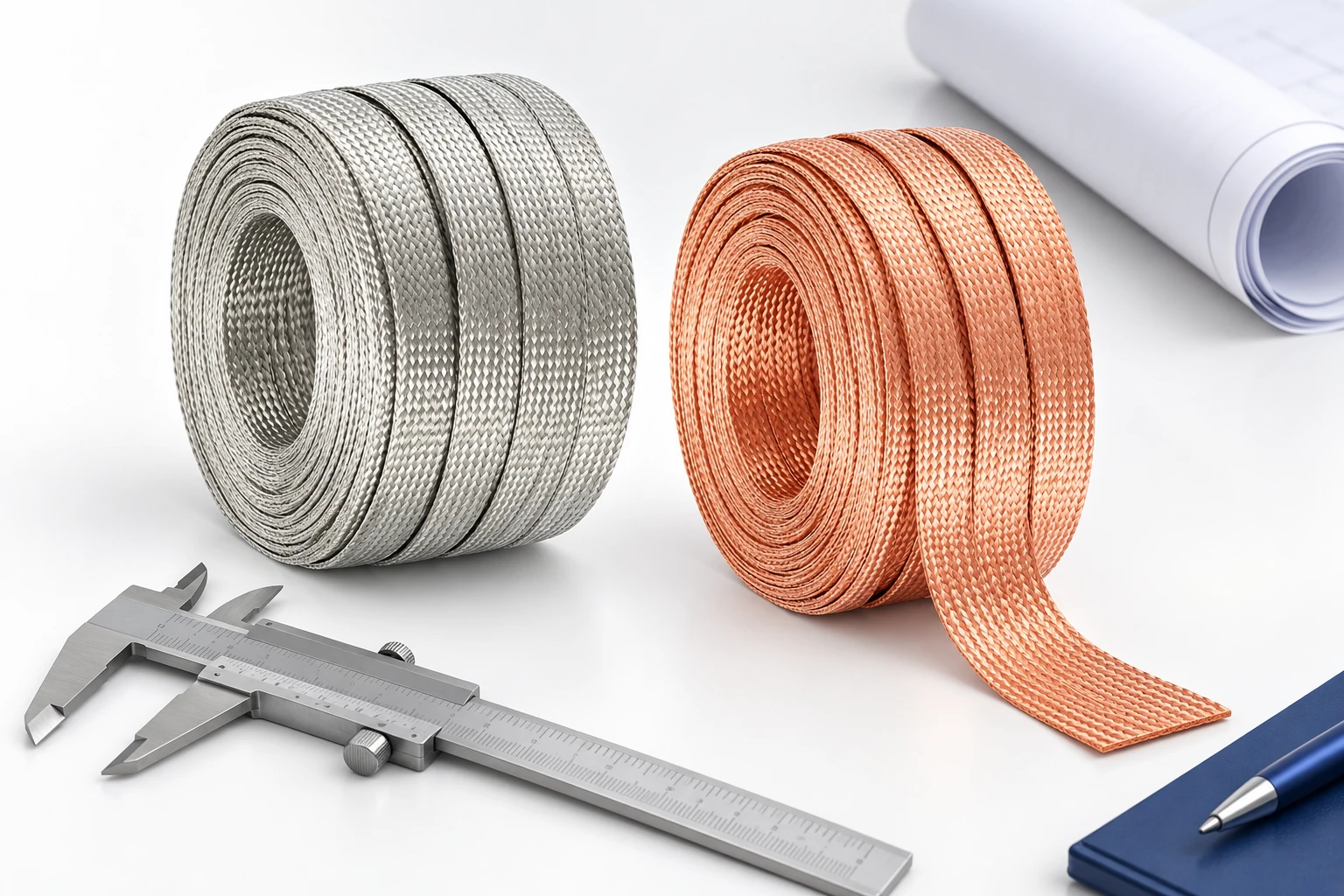
Separate copper content from the space it occupies
A flat braid consists of many interlaced wires, with spaces between them. Its overall width and thickness describe the space occupied by that woven structure, including voids. They are useful for clearance and mounting, but their product is not the same as the combined metal area of the wires. Harger lists nominal width and thickness separately from conductor gauge and circular-mil area. When comparing quotations, require conductor cross-section as its own field rather than allowing an envelope measurement to stand in for it.
Ask how the nominal conductor area is established
For equal round strands, the sum of strand areas is calculated from the number of strands multiplied by the area of one strand. The underlying geometry is N × π × d² / 4, where d is strand diameter. Bridgold's manufacturer guidance illustrates this approach for flat braid. Use it to understand a construction description, not to certify a finished product from a photograph. Ask for the nominal conductor area, strand construction, material, and an appropriate resistance specification when electrical equivalence matters.
Distinguish continuous current, fault duty, and bonding
A braid used as a power connection, protective bonding link, or shielding connection does not face an identical selection problem. State the intended function before asking for a size. Continuous current requires an appropriate thermal basis; fault duty adds current magnitude and duration; a moving connection adds mechanical requirements. Terminal design and installed routing also belong in the review. Request application-specific engineering confirmation rather than deriving an ampere rating from width, thickness, or another supplier's similarly sized product.
Specify the terminals and movement allowance
Provide the distance between connection points, required hole size and spacing, terminal orientation, maximum available width and thickness, and expected motion. Define whether a length refers to overall length, flexible length, or hole centers so quotations can be compared consistently. Include conductor finish and any insulation requirement. For DUCHUANG copper braid inquiries, request a drawing showing both electrical cross-section and mechanical dimensions. Review the finished assembly against the actual mounting surfaces, fastening arrangement, and movement before accepting a sample for repeated production.
Common questions
Is a braid 20 mm wide and 2 mm thick a 40 mm² conductor?
Not necessarily. Those dimensions describe an envelope that includes gaps. Ask for the nominal copper cross-section and supporting construction or resistance data.
Can two braids with equal copper area have different widths?
Yes. Braid construction and shaping affect the outer dimensions. Compare conductor area for copper content and the drawing for mechanical fit.
Can I select braid ampacity from conductor area alone?
No. The duty, installation, temperature limits, terminals, and applicable design requirements must also be considered. Obtain an appropriate rating or engineering confirmation.
Explore related products
Browse dimensional referencesNeed a product recommendation?
Send the dimensions, material, operating conditions and quantity. Our team will review the requirement for your installation.
Discuss your specificationFurther reading
Technical background from manufacturer publications. Product-specific values and approvals apply to the referenced manufacturer and configuration.