
PRODUCT SELECTION
How to Specify a Gooseneck Tube for Load, Reach and Adjustment
Specify a gooseneck tube around the complete supported assembly: load, centre of gravity, unsupported length, working orientation, end fittings and adjustment needs. Diameter is only one input. Confirm holding performance on a sample built to the intended length and mounting arrangement.
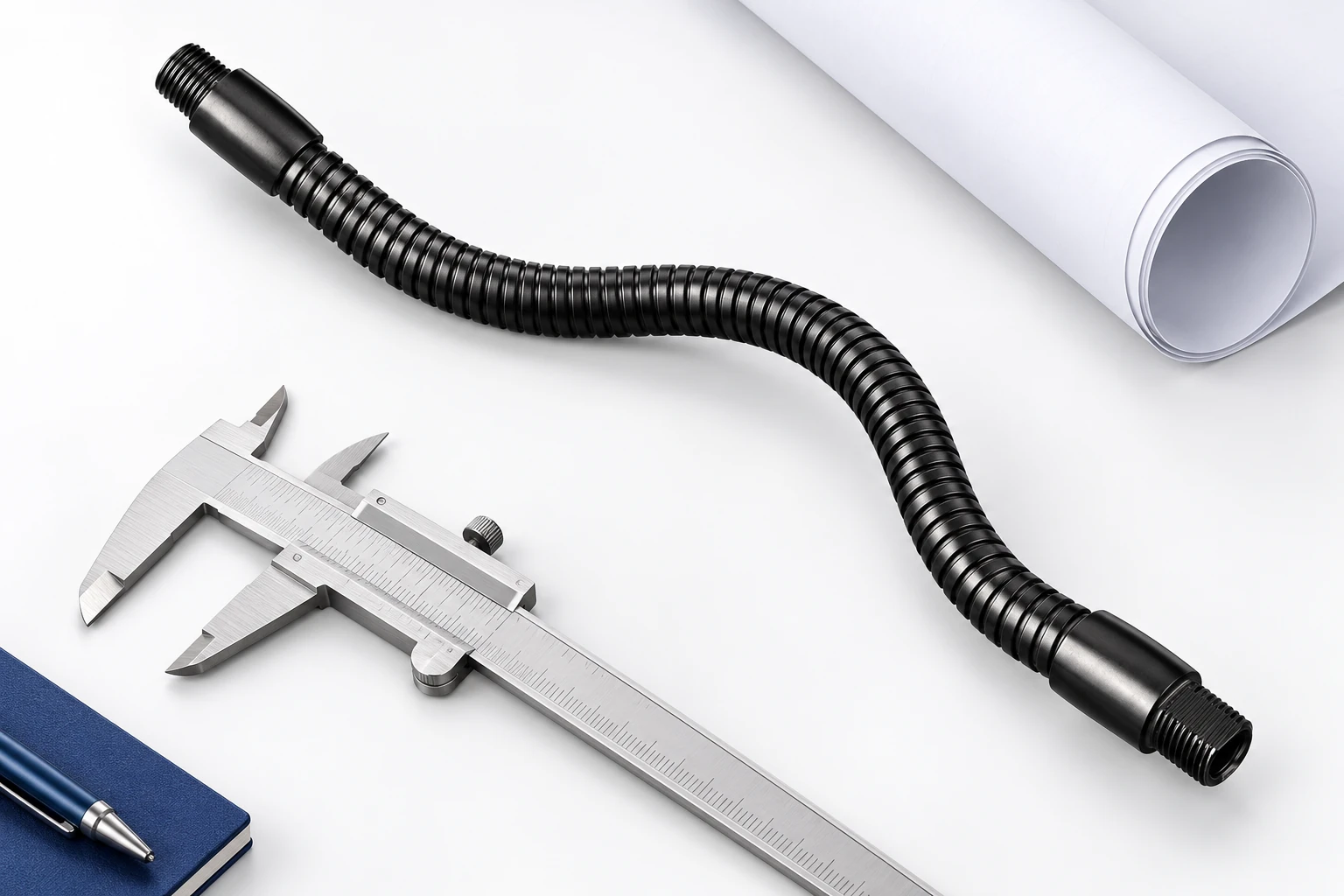
Describe the load at its working reach
Give the mass of the complete supported head, including its bracket, cable and accessories. Show its centre of gravity and the distance from the fixed mounting point in the most demanding intended position. A longer reach changes the load effect even when the head remains the same. Hagitec publishes separate holding references for different lengths and orientations, illustrating why a single diameter cannot establish the capacity of every assembled gooseneck.
Define the tube and both interfaces
Specify outside diameter, clear bore where cables must pass, and the finished assembly length. Distinguish tube length from the overall length including fittings. Draw both interfaces with thread designation, engagement, shoulder and mounting details where relevant. Hagitec describes custom end attachments and several finishes. Treat these as separate selection choices: a finish description does not determine the internal construction, and a visually similar end does not establish thread compatibility.
Balance holding ability with adjustment
State the expected bend shape, minimum space available for bending and how often the user will reposition the arm. Also describe the base, mounting surface and surrounding conditions. A tube that holds the head but requires excessive force to adjust may be unsuitable for the application. Ask the supplier to review stiffness together with the mounting arrangement, then evaluate the complete sample with the intended cable installed through its bore where applicable.
Agree a practical sample review
Use a sample close to the final assembly, with the actual head or a representative test load at the correct centre of gravity. Review the required positions, ease of movement and any position drift over an agreed observation period. Define repeat-adjustment checks where needed. Record the accepted configuration and test conditions with the drawing. A short loose tube sample or a reference manufacturer's dimension table cannot establish performance for a different finished assembly.
Common questions
Does a larger diameter guarantee a higher load rating?
No. Construction, unsupported length, orientation and the complete mounting arrangement also matter.
Is a flexible cable conduit a gooseneck support?
Only a product with verified position-holding performance should be selected to support a fixture.
Can the catalogue holding figures be copied to another model?
No. Use the specified model and test configuration, or obtain confirmation for the quoted assembly.
Explore related products
Browse dimensional referencesNeed a product recommendation?
Send the dimensions, material, operating conditions and quantity. Our team will review the requirement for your installation.
Discuss your specificationFurther reading
Technical background from manufacturer publications. Product-specific values and approvals apply to the referenced manufacturer and configuration.