PRODUCT SELECTION
2:1 vs 3:1 Heat Shrink Tubing: How to Choose the Right Size
Choose heat shrink tubing that clears the largest installation feature and recovers below the smallest surface it must grip. A 3:1 ratio spans a larger diameter change than 2:1, but actual supplied diameter, recovered diameter, and wall thickness decide suitability.
Read shrink ratio together with both diameters
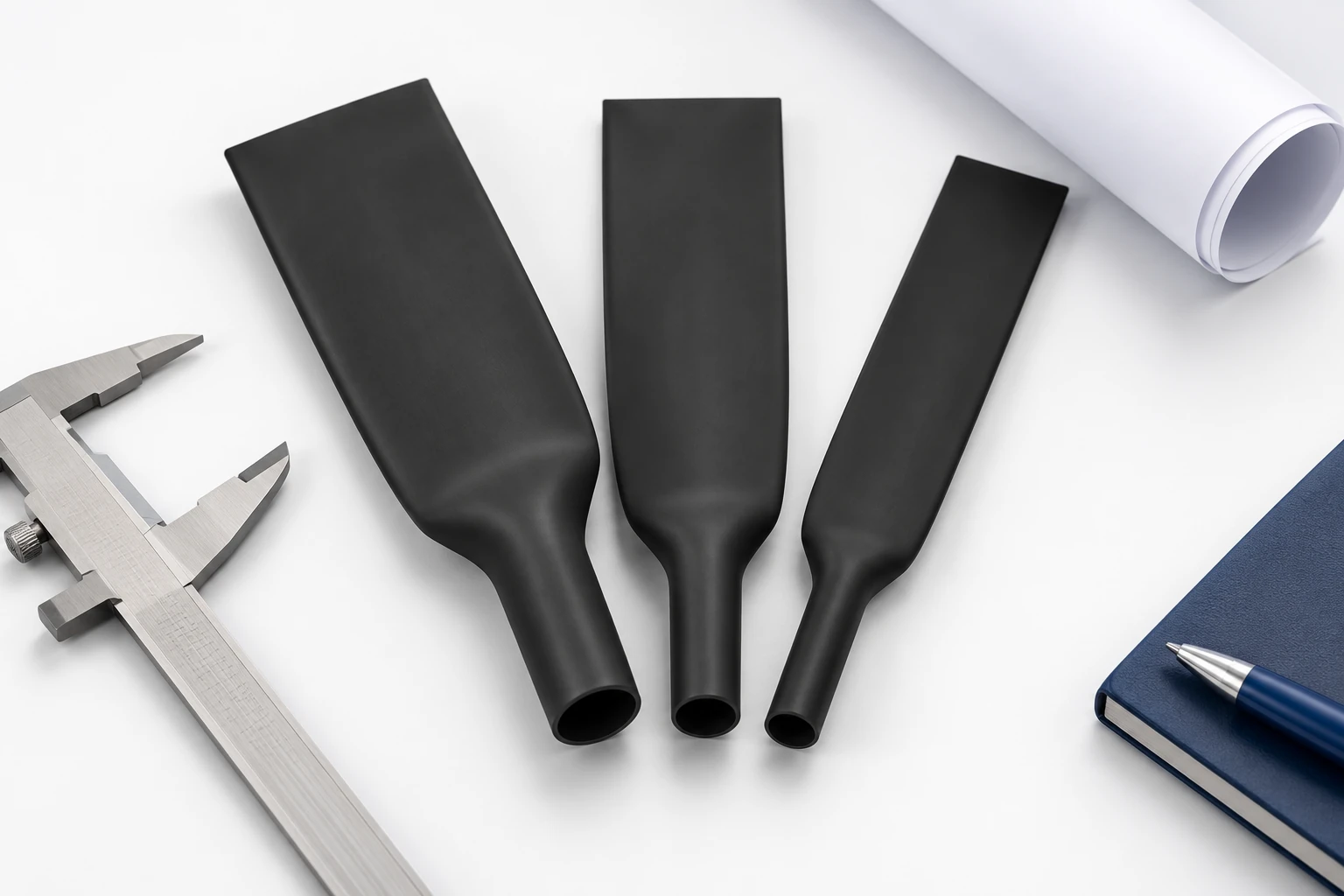
A 2:1 ratio describes tubing capable of recovering to roughly half its expanded diameter; 3:1 describes a greater diameter reduction. The product table remains the controlling reference because it specifies the supplied and fully recovered dimensions. Record the largest feature the tubing must pass over and the smallest surface beneath the finished sleeve. Include connector housings, splice bulges, and cable tolerances. Shrink ratio alone cannot tell you whether a particular size will slide into place or remain tight after recovery.
Use a stepped assembly to test the selection
Consider an illustrative assembly with a connector approximately 10 mm across and a cable approximately 5 mm in diameter. Tubing marked 12/6 would clear the connector, but its stated recovered diameter would remain larger than the cable. Tubing marked 12/4 could be a candidate, subject to installation clearance, tolerances, and the manufacturer's recommended recovery range. These numbers explain the selection logic only. They do not describe an available DUCHUANG size, and nominal dimensions must not replace a sample fit on the actual assembly.
Evaluate wall, material, and installation heat separately
The ratio does not specify adhesive, dielectric properties, flexibility, flame behavior, or the temperature needed for installation. TE offers single-wall tubing in multiple shrink ratios, demonstrating that a higher ratio does not automatically mean adhesive lining. Check the required wall thickness after recovery and whether the assembly can tolerate the installation process. Review longitudinal change where sleeve length matters. For production, define a repeatable heating method and inspect the finished result rather than accepting diameter reduction as the only sign of correct installation.
Write the order around the finished application
An effective inquiry states expanded and recovered diameter requirements, the largest pass-over feature, the smallest substrate, sleeve length, and whether adhesive is needed. Add service temperature, material restrictions, color, printing, and the required documentation. Ask the supplier to recommend a size with usable recovery margin, rather than choosing a sleeve exactly at its limiting dimensions. Trial the recommended tubing on representative components, including dimensional extremes, before locking the purchase specification. Keep the validated part description and installation method together for repeat orders.
Common questions
Is 3:1 heat shrink always better than 2:1?
No. It accommodates a larger diameter change, but the right choice also depends on size, wall thickness, material, installation conditions, and the protection required.
Does 3:1 mean the tubing contains glue?
No. Shrink ratio and adhesive lining are separate attributes. Confirm both in the product description.
Can I use the fully recovered diameter as the cable diameter?
Avoid selecting solely at that limit. Follow the manufacturer's sizing guidance and allow for component tolerances and sufficient recovery onto the substrate.
Explore related products
Browse dimensional referencesNeed a product recommendation?
Send the dimensions, material, operating conditions and quantity. Our team will review the requirement for your installation.
Discuss your specificationFurther reading
Technical background from manufacturer publications. Product-specific values and approvals apply to the referenced manufacturer and configuration.